AI Engineering is the practice of building software powered by AI models.
Instead of training models from scratch, AI Engineers integrate models such as GPT, Claude, Gemini, and Llama into real applications.
The focus is not just the model. It is the system around it — data, APIs, retrieval, tools, evaluation, security, and deployment.
AI Engineering vs ML Engineering
ML Engineers typically build, train, and optimise models.
AI Engineers use existing models to build complete applications around them.
For most software developers entering AI, the focus is therefore building AI-powered products rather than training models.
The AI Engineering Stack
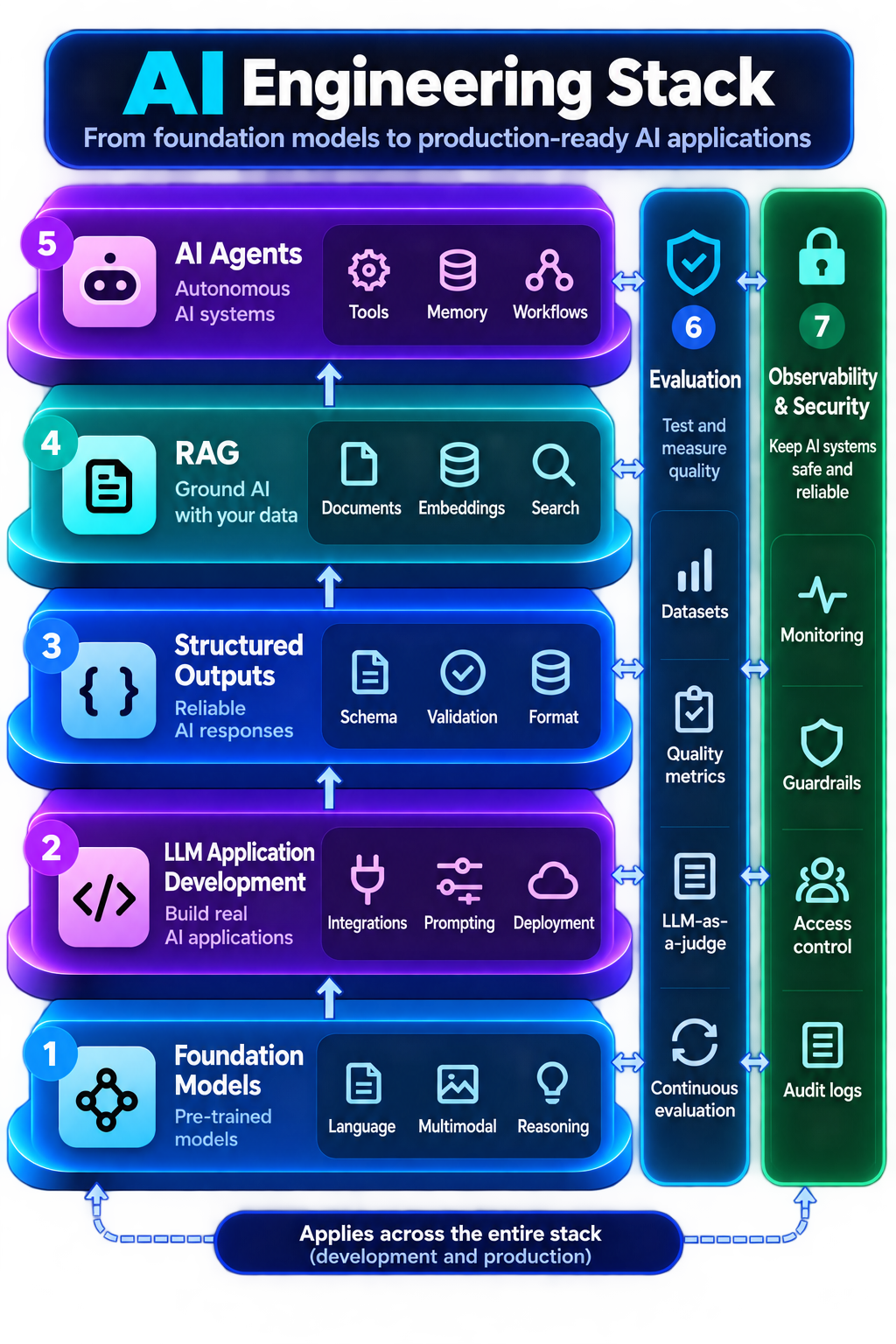
1. Foundation Models
Models such as GPT, Claude, Gemini, Llama, and Mistral provide the intelligence behind AI applications.
Model selection is a trade-off between quality, speed, cost, context, and privacy. The most powerful model isn't always the right choice.
2. LLM Applications
An LLM API is only the starting point.
Production applications also need input validation, prompts, output validation, error handling, integrations, and cost control.
3. Structured Outputs
Software needs predictable data, while LLMs naturally produce text.
Structured outputs let developers define a schema — using tools such as Pydantic or Zod — so model responses can be used reliably by applications.
4. RAG
Retrieval-Augmented Generation (RAG) gives an LLM access to external knowledge.
A typical RAG system:
Documents → Chunks → Embeddings → Vector Database → Retrieval → LLM
RAG is useful for company knowledge, documentation, support systems, and other applications where the model needs current or private information.
5. AI Agents
AI agents allow LLMs to use tools and complete multi-step tasks.
They can search documents, call APIs, query databases, and execute workflows.
Key challenges include tool design, permissions, state, memory, and human approval.
6. Evaluation
AI applications cannot be tested only with traditional unit tests.
Teams use golden datasets, automated evaluations, LLM-as-a-judge, human feedback, and regression tests to measure quality.
7. Observability & Security
Production AI systems need visibility into latency, tokens, model responses, retrieval, tool calls, and errors.
They also introduce risks such as prompt injection, data leakage, and tool abuse. Security controls therefore need to cover the entire AI pipeline.
Skills You Need
A practical AI Engineering path has four stages:
- Software Engineering — Python, APIs, databases, Git, testing, Docker
- AI Development — LLM APIs, prompting, structured outputs, embeddings, RAG
- Agentic AI — tools, agents, memory, MCP, workflows
- Production AI — evaluation, observability, security, deployment, cost optimisation
The best way to learn is to build:
LLM Assistant → RAG Application → AI Agent → Production AI System
Learn AI Engineering by Building
At Auragile, we provide practical software engineering training for developers and technical professionals, including AI Engineering.
Our approach is simple: learn the concepts, build real applications, and develop skills you can use in production.